
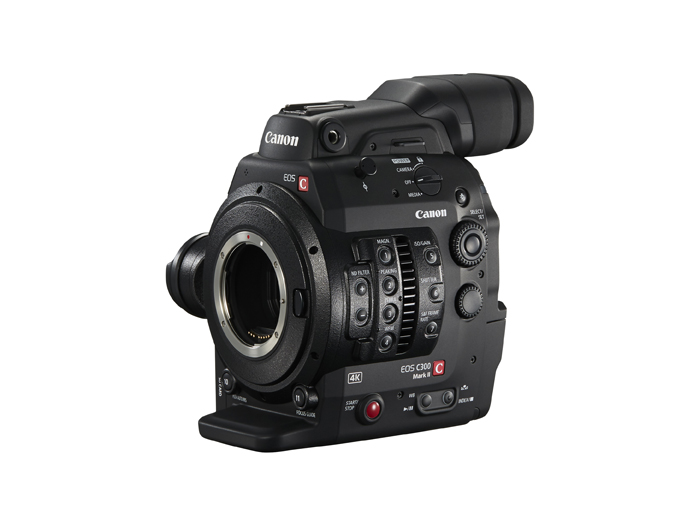
Canon C300 Mark II – [Image source: Canon USA]
Abstract:
The Canon C300 Mark II camera promises on paper to give an unprecedented level of color fidelity and rendition at its price point. With an exposure ramp test, I set out to make a first exploration of this new product’s in-camera 12-bit color capabilities and touted dynamic range and found some interesting results. It does indeed have the ability to describe 15 stops of light, and I also found that out of the camera’s four offered color spaces, Canon’s Cinema Gamut color primaries provide the most naturalistic colors without extensive secondary color grading. Unfortunately, strange electronic artifacts in my particular test camera prevented me from accurately discerning how many of those 15 stops to be useable (above pattern and shot noise threshold) for tonal reproduction. I presume this issue will be fixable with a firmware update as soon as possible and does not universally describe the product line.
Part 1: Introduction & Background

If someone handed you a brand new camera you’ve never seen and asked you to shoot a project with it, what steps do you take to familiarize yourself with it before the shoot?

One can test its resolution performance, or the way it renders motion, or its ergonomics on the shoulder or whilst dollying on a Fisher 11, but one first needs to know how a camera or imaging system responds to color and light. Such an understanding provides the foundation for building or utilizing a preexisting look, as well as corollary issues dictated by exposure: filtration needs, lighting needs, grip needs, & power needs. For example, what if a documentary cinematographer had to shoot an interview in a dark, skylit room—how would the camera’s low-light noise characteristics inform the lensing and lighting approach?
Enter a classic mainstay solution for professional cinematographers:
an exposure ramp test (also known as the good old “over/under” test) in which, under strictly controlled lighting conditions, the cinematographer generates a series of bracketed exposures of a well-defined and understood subject or scene.
This type of camera test can widely vary in its form and methodology, but all forms of this test systematically explore a camera’s response to light throughout and beyond its exposure range. This technical test eschews creative input to clearly understand the imaging system’s repeatable color capabilities, which in turn enables filmmakers truly creative future use of the camera. The key elements I keep in mind when I perform this test are the following:
- Optical consistency
- Tonal Variety
- Manufacturer-accurate and even exposure
- Real world relevance
For an inaugural post on this subject, I tested Canon‘s new C300 Mark II camera with Kee Kyung, a fellow cinematographer. It’s fresh off the assembly line with boldly proclaimed specifications for light & color rendition:
- 15 stops of dynamic range with 6 1/3 stops highlight latitude in a new Cineon-based log curve, Canon Log 2
- 4 different sets of color primaries to describe the color within those stops
- 10 bit and 12 bit depth color resolution
- 422 and 444 color sampling
I set out to explore how the camera performs straight out of the box with this simple exposure ‘stress’ test. In this multi-part series, I will delve into my methods, organizing and analyzing the results, and forming clear conclusions about how to use this camera for production.
 PROCESS
Great job Tim. I love this blog.
LikeLike
Thanks Ahmed – stay tuned for more. It will also feature non-technical material focusing on the aesthetics and philosophy behind imagemaking as well.
LikeLike
Looks good so far. Looking forward to seeing your analysis.
LikeLike